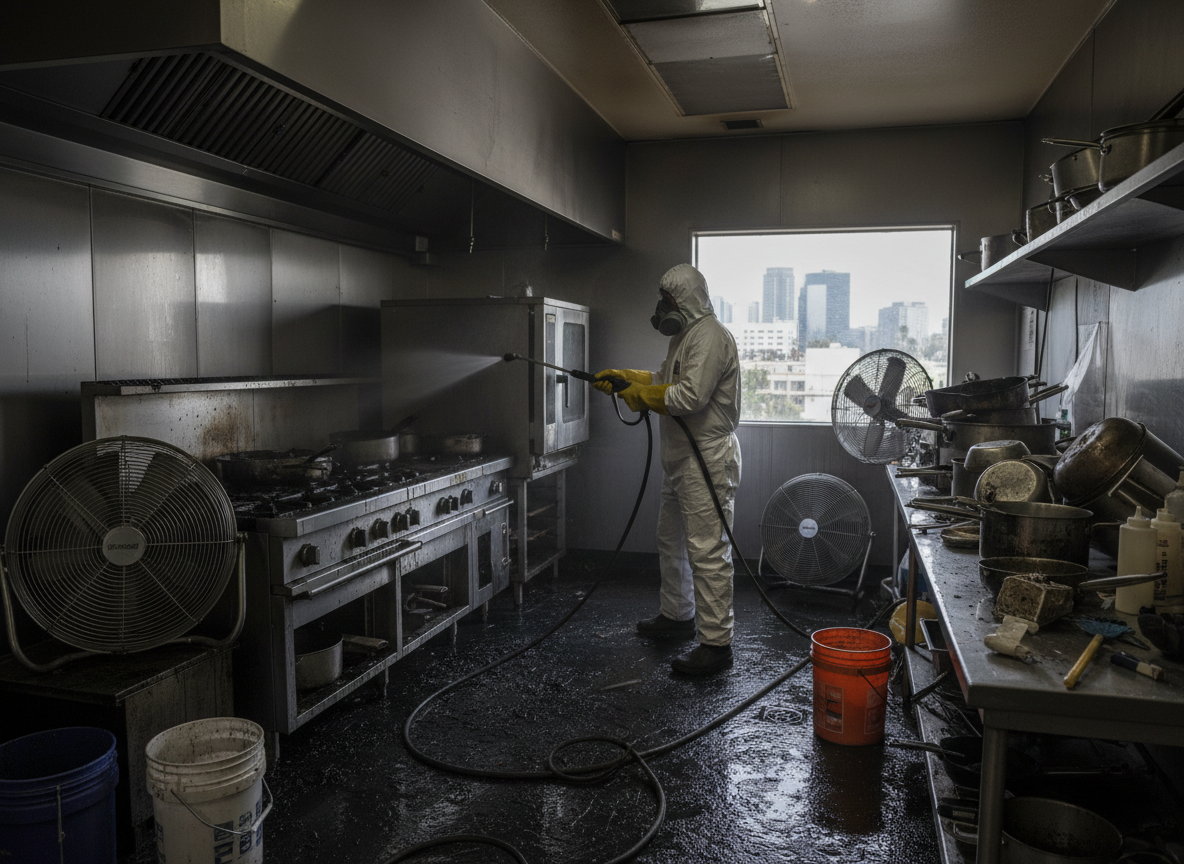
Kitchen fires in Universal City often start from unattended cooking oils or faulty appliances in homes built from the 1960s onward. These fires produce heavy grease-laden soot that travels through shared wall cavities and into attics. The Mediterranean climate keeps winters mild but summers dry, allowing fine particles to remain airborne longer and settle into porous surfaces like popcorn ceilings and textured drywall common in the area. Technicians must test for hidden migration into HVAC returns that serve multiple rooms before any cleaning begins.
Cleanup begins with isolating the kitchen to prevent cross-contamination, then removing charred cabinetry and countertops while documenting layers of soot on stainless appliances versus laminate surfaces. Los Angeles County building codes require verification that electrical boxes and gas lines remain intact after heat exposure. Odor neutralization uses thermal fogging matched to the specific protein-based residues from cooking fires rather than standard deodorizers. Final air scrubbing continues until particle counts match pre-loss baselines recorded on-site.
Edge cases include fires that travel upward through range hood ducts into second-floor bedrooms, requiring removal of insulation batts that have absorbed smoke. Stucco exteriors around kitchen windows can trap residue in weep holes, leading to exterior staining if not addressed. Homeowners sometimes attempt DIY cleaning with pressure washers that drive soot deeper into grout lines on tile floors typical in Universal City kitchens.
Technician insight
In Universal City, the thing that catches most people out with Kitchen fire cleanup is how dry summer air lets grease soot travel through the older shared HVAC runs that serve homes clustered near Universal Studios Hollywood, requiring full trunk-line cleaning instead of just the kitchen.
Hidden Soot in Attic Ducts
A kitchen range fire sent smoke upward through a vent in a single-story Universal City home. Inspection found fine residue coating insulation and duct interiors above the ceiling. Crews removed contaminated insulation, cleaned the full trunk line, and restored the space without disturbing the rest of the house.
How it works
- 1
Initial Assessment
Technicians inspect the kitchen, test adjoining rooms for smoke migration, and document affected materials while the property remains secured.
- 2
Containment and Removal
Plastic barriers isolate the space, then charred debris and heavily contaminated cabinetry are removed to prevent further odor transfer.
- 3
Surface Cleaning
HEPA vacuuming and specialized degreasers treat walls, ceilings, and appliances, followed by thermal fogging matched to cooking residues.
- 4
Restoration and Verification
New materials are installed where needed, HVAC systems are cleaned, and air quality is retested before the kitchen is returned to use.
Pricing
Cost depends on square footage affected, depth of smoke penetration into walls and ducts, and whether structural materials must be replaced.