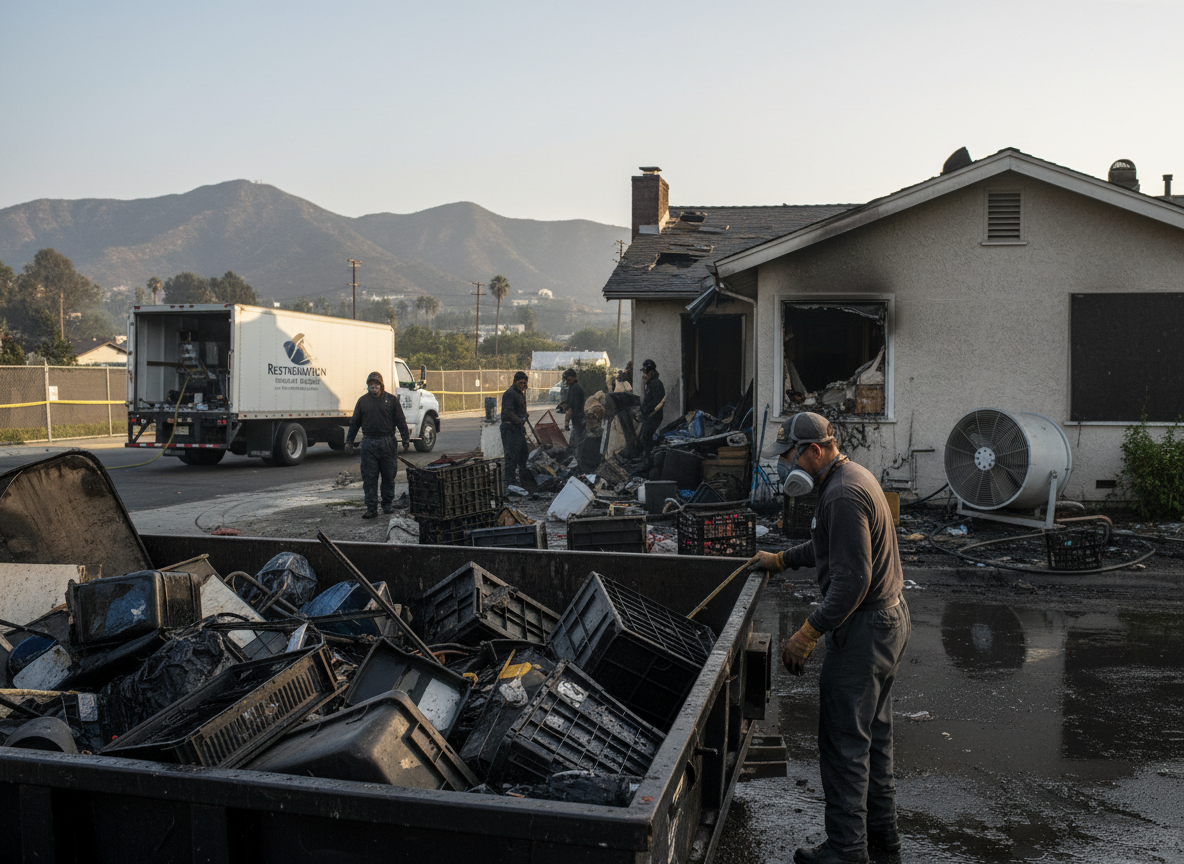
Hoarding cleanup after fire in Universal City often involves older housing stock built mid-century near Universal Studios Hollywood where accumulated belongings trap soot deep into fabrics, drywall and insulation. Mediterranean climate with mild winters means slower evaporation rates in enclosed spaces, allowing hidden moisture from suppression efforts to linger and create secondary mold risks behind stacked items. Technicians must navigate narrow pathways through Los Angeles County homes while containing airborne particles that can migrate to neighboring units in multi-family buildings common around the area.
Edge cases include charred paper and plastic collections that release toxic off-gassing during removal, requiring negative air machines and sealed containment before any sorting begins. Code considerations in Los Angeles County may trigger additional inspections when structural elements are compromised by both fire and heavy stored loads. Homeowners frequently underestimate how embedded odors travel through HVAC systems in these hillside and flatland properties, making full duct cleaning essential rather than optional.
Workmanship focuses on documenting every item category for insurance while safely discarding irreparably damaged goods without disturbing adjacent structures. Upfront quotes follow a detailed walk-through because volume and contamination levels vary widely between properties.
Technician insight
In Universal City the thing that catches most people out with hoarding cleanup after fire is how the mild winters keep moisture trapped longer inside older buildings near Universal Studios Hollywood, so hidden pockets behind stacked boxes stay damp and need extra days of targeted drying before walls can be sealed.
Cluttered Smoke Damage in Studio-Area Home
A Universal City residence near the studios suffered kitchen fire spread into rooms packed with stored belongings. We found soot embedded throughout layers of paper and fabric while mild winter humidity kept subfloor moisture elevated. Containment and systematic removal allowed safe extraction of contaminated items followed by targeted drying and cleaning, restoring habitable conditions without further mold development.
How it works
- 1
Initial Assessment
Technicians evaluate fire damage extent, hoarding density and affected materials while documenting conditions for insurance.
- 2
Containment Setup
Negative air pressure and plastic barriers isolate the work zone to prevent soot migration throughout the Universal City home.
- 3
Item Removal and Sorting
Contents are categorized, removed and disposed of or set aside for cleaning based on contamination level and salvageability.
- 4
Deep Cleaning and Odor Removal
HEPA vacuuming, chemical sponges and ozone or hydroxyl treatments address embedded smoke residues in remaining surfaces and cavities.
- 5
Final Verification
Air quality testing and visual inspection confirm the space meets restoration standards before re-entry.
Pricing
Pricing varies by volume of contents and contamination depth; contact for an upfront quote after inspection.