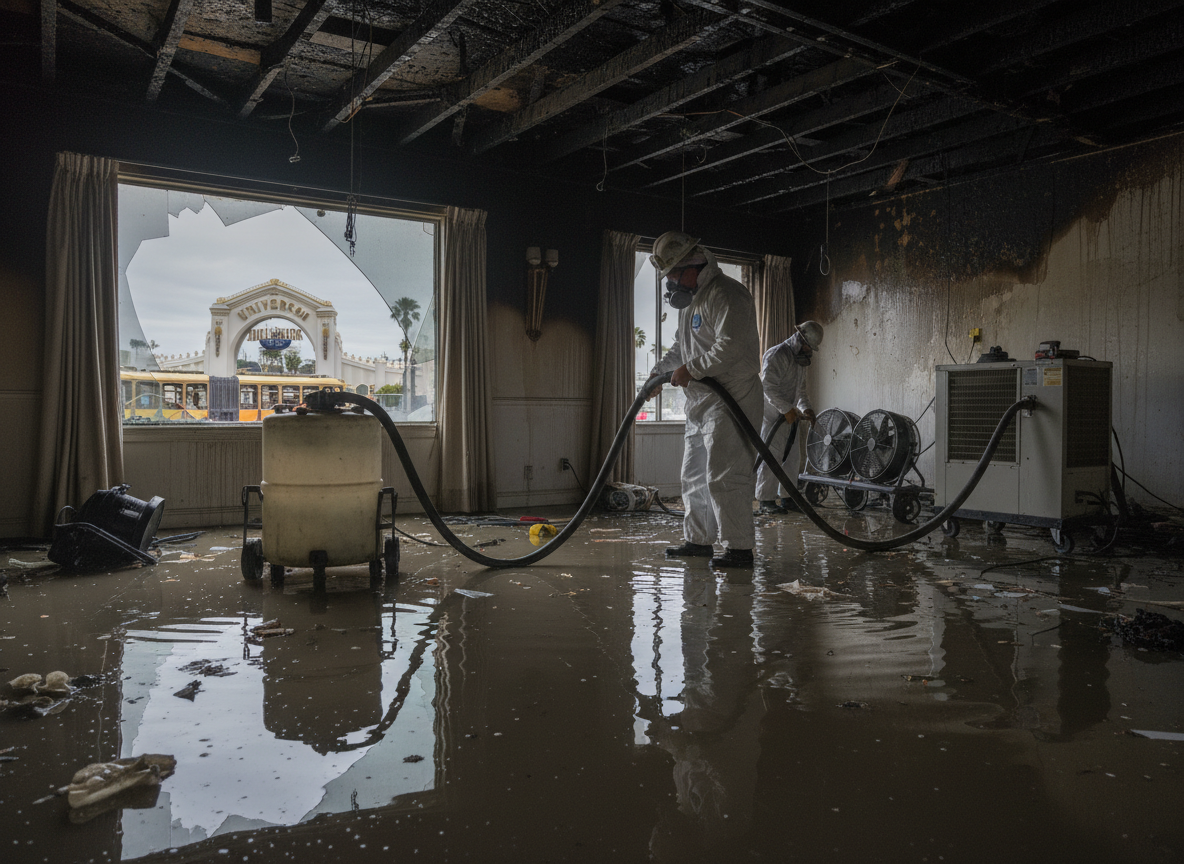
Universal City homes near Universal Studios Hollywood often feature mid-century construction with wood framing and older electrical systems that complicate fire and flood restoration. When a fire occurs, suppression water saturates drywall, insulation, and subfloors, creating conditions for rapid microbial growth even during mild winters typical of the Mediterranean climate in Los Angeles County. Technicians must address both charred materials and hidden moisture pockets behind stucco or in crawl spaces common to hillside lots in the area.
Flooding from broken pipes or heavy seasonal runoff interacts with fire residue to produce acidic soot that corrodes metal fixtures and HVAC components. In neighborhoods surrounding Universal City Plaza, limited lot sizes mean equipment placement requires careful coordination to avoid disrupting adjacent properties. Restoration crews extract water within hours, then use moisture meters to confirm drying before reconstruction, preventing long-term structural issues in Los Angeles County buildings exposed to repeated wet-dry cycles.
Edge cases include smoke migration through shared walls in multi-unit buildings near Universal Studios Hollywood and the need to coordinate with local permitting for any structural repairs. Mild winters reduce natural evaporation rates, so dehumidification runs longer than in drier inland zones. Proper documentation of pre-existing wear in older Universal City housing stock helps avoid disputes during insurance claims.
Technician insight
In Universal City, the thing that catches most people out with Fire and flood restoration is how mild winters slow drying in older wood-framed homes near Universal Studios Hollywood, allowing hidden moisture to linger behind walls if crews do not run extended dehumidification.
Combined fire and pipe burst in hillside home
A kitchen fire in a Universal City residence spread to adjacent walls while a ruptured supply line added water. Crews found saturated insulation and acidic soot on HVAC ducts. Extraction and targeted drying prevented mold, and selective material replacement restored the space without full demolition.
How it works
- 1
Initial Assessment
Technicians arrive within hours to document fire and water damage, test moisture levels, and identify affected materials in Universal City structures.
- 2
Water Extraction and Containment
Standing water is removed using pumps and vacuums while containing soot to prevent cross-contamination in Los Angeles County homes.
- 3
Drying and Dehumidification
Industrial equipment dries saturated areas over several days, accounting for mild winter humidity that slows evaporation near Universal Studios Hollywood.
- 4
Cleaning and Restoration
Surfaces are cleaned, damaged materials replaced, and the property returned to pre-loss condition with final verification.
Pricing
Upfront quotes provided after on-site assessment; costs depend on square footage affected and combined fire-water scope.