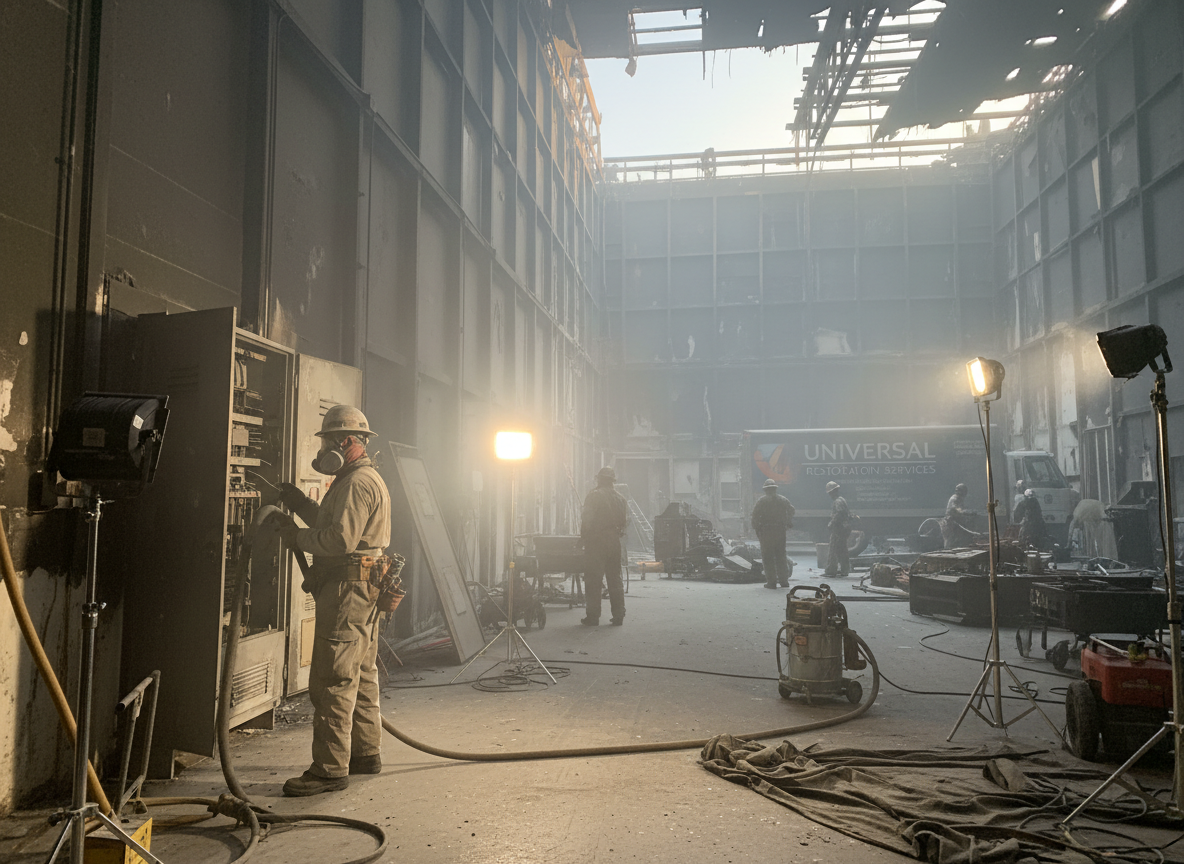
Commercial properties in Universal City often sit in mixed-use buildings near Universal Studios Hollywood where aging electrical systems from the 1970s and 1980s meet modern HVAC upgrades. After a fire, soot migrates through shared ductwork into adjacent suites, requiring negative-air machines and HEPA filtration that residential crews rarely scale correctly. Mediterranean winters with low humidity let fine smoke particles stay airborne longer, so clearance testing must account for re-suspension during tenant fit-outs rather than assuming a single wipe-down suffices.
Los Angeles County commercial codes require separation of fire-damaged materials from salvageable inventory within 48 hours to limit business interruption claims. We coordinate with building management to isolate affected floors while keeping ground-level retail entrances open when possible. Concrete tilt-up walls common in the area hold heat longer than wood-frame construction, so hidden charring behind metal studs often shows up only after thermal imaging and selective demolition.
Edge cases include restaurants with grease-laden exhaust systems where fire travels into rooftop units and drops particulate into dining areas below. We document pre-existing wear on terrazzo or polished concrete floors so insurance adjusters see the difference between fire damage and normal foot traffic. Owner-operated businesses near the 101 freeway benefit from our 24/7 dispatch because traffic patterns can delay daytime equipment deliveries by two hours or more.
Technician insight
In Universal City the thing that catches most people out with Commercial fire restoration is how quickly soot travels through the shared rooftop HVAC that serves both studio-adjacent offices and ground-floor retail. The mild winter humidity here keeps particles from settling, so if you skip the second day of air scrubbing you will fail clearance testing when the system kicks back on.
Office Suite Above Retail Near Universal Studios
A small electrical fire started in a second-floor office HVAC unit and sent soot through the shared duct into the retail space below. We isolated the floor with temporary barriers, ran continuous negative air for 36 hours, and cleaned the common exhaust while the retail tenant stayed open. Clearance testing passed on the third day and both spaces reopened without further interruption.
How it works
- 1
Emergency Site Securement
Board up openings, set up containment, and establish negative pressure to prevent soot spread into unaffected commercial spaces.
- 2
Damage Assessment and Documentation
Thermal imaging and moisture mapping of concrete and metal structures followed by detailed photo logs for Los Angeles County permit requirements.
- 3
Soot and Smoke Removal
HEPA vacuuming, chemical cleaning of hard surfaces, and air scrubbing calibrated for the dry Mediterranean climate that keeps particles suspended.
- 4
Structural Drying and Odor Neutralization
Targeted drying of affected walls and inventory plus hydroxyl or ozone treatment sized for large open-plan commercial layouts.
- 5
Final Clearance and Handover
Third-party air quality testing and walkthrough with property management before tenants return.
Pricing
Commercial jobs are quoted after on-site assessment because square footage, HVAC complexity, and inventory volume drive the largest cost variables.